Set this page to:
Go to FERI in:
 CONTACT
 CONTACT
 Login
Login
 Languages

Just a few years ago, they were a niche phenomenon in the crypto market; now they are an increasingly important component of the global financial architecture: Stablecoins are rapidly gaining significance for capital markets and international payment flows. “However, the fact that stablecoins are predominantly pegged to the U.S. dollar also gives rise to significant and often still underestimated geopolitical side effects,” explains Dr. Heinz-Werner Rapp, founder and director of the FERI Cognitive Finance Institute. In its latest study, “Stablecoins – How Tokenized Money Is Changing the Global Financial Architecture,” the Bad Homburg-based think tank examines the role stablecoins play in the global digital financial infrastructure and the future consequences that are emerging for the economy, politics, and financial markets.
“Stablecoins are blockchain-based units of value that aim to maintain a fixed peg to reference assets such as the U.S. dollar. To this end, corresponding reserves are held—mostly in short-term U.S. Treasury bonds or gold,” explains Rapp. Unlike well-known cryptocurrencies such as Bitcoin or Ether, stablecoins aim for value stability and efficient convertibility: “Their basic principle is the provision of digital and programmable money—not through actual money creation, but through the tokenization of existing financial assets.”
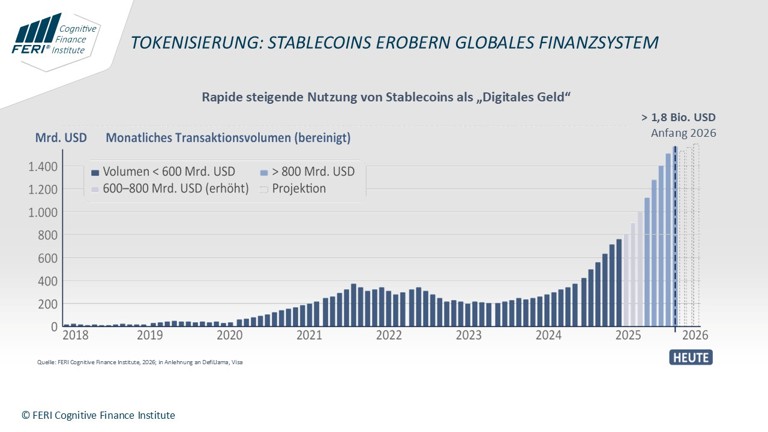
With a market volume of over $300 billion and monthly transaction volumes in the trillions, stablecoins have long since arrived at the center of the institutional financial architecture. “They have thus reached a scale that is increasingly blurring the traditional boundaries between the crypto economy and the traditional financial system,” says Rapp. Stablecoins enable fast, low-cost cross-border transactions and provide access to digital dollar liquidity even in developing and emerging markets with unstable currencies. A key driver here is the rapid rise of tokenization—that is, the digital securitization of real monetary or financial assets.
However, the current stablecoin ecosystem also poses enormous geopolitical risks: “About 97 percent of all stablecoins are currently denominated in U.S. dollars—thereby reinforcing the dollar’s dominance in the digital realm as well,” warns Rapp. This could further cement the global dominance of the U.S. currency and thus expand the U.S.’s influence over international financial flows. “From the U.S. side, this is entirely intentional from a political standpoint—and since 2025, it has even been legally enshrined in the ‘GENIUS Act,’” says Rapp.
This poses a massive strategic challenge for Europe: “Without a competitive digital payment infrastructure, there is a risk of deepening dependence on U.S.-controlled financial architectures.” However, this explosive geopolitical dimension is not yet being discussed in Europe with the necessary seriousness and clarity.
The European Union has indeed established its own comprehensive regulatory framework for stablecoins with the MiCAR (Markets in Crypto-Assets Regulation) framework. However, according to Rapp, whether euro-denominated stablecoins could become a genuine alternative to U.S.-dominated digital currencies in the coming years depends on two factors: the speed of MiCAR implementation and the willingness of European banks and financial intermediaries to actually use and distribute tokenized euro payment instruments. “The U.S. has clearly left Europe in the dust on the future-oriented topic of stablecoins—the response to this must now be strategic and coordinated.”
Despite structural shortcomings, entrepreneurs and professional investors should already be preparing for the rapidly growing significance of stablecoins—both for the further digitization of the global financial system and for the emergence of a future “token economy”: “Stablecoins create a new, dynamically growing area of tension at the intersection of payment transactions, the money market, regulation, and market infrastructure,” says Rapp, explaining the central aspect of the study.
In its study, “Stablecoins – How Tokenized Money Is Changing the Global Financial Architecture,” the think tank of the Bad Homburg-based FERI Group analyzes current developments in the stablecoin sector. It examines the opportunities that digital money offers in principle, as well as the challenges facing Europe.
The study was produced in collaboration with crypto and digital expert Dr. Michael Blaschke and builds on the institute’s previous work on tokenization. A short version of the analysis is available in German for download on this page.