Set this page to:
Go to FERI in:
 CONTACT
 CONTACT
 Login
Login
 Languages

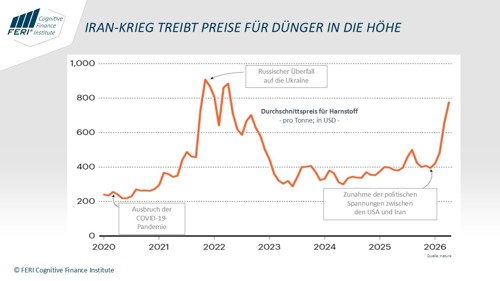
A geopolitical conflict, a maritime bottleneck—and fertilizer prices are rising worldwide. The current price shock shows just how quickly regional escalations can put pressure on global supply chains.
In just a few weeks, the price of urea has risen by about 50 percent. This is not just short-term market noise, but a structural warning sign.
Urea is the world’s most important nitrogen fertilizer. It provides plants with essential nutrients and is crucial for crop yields and global food production. If urea prices rise sharply, this has a direct impact on agricultural production and food prices.
The COVID-19 pandemic and the war in Ukraine have already shown how sensitive fertilizer markets are to geopolitical escalations and systemic shocks. The war in Iran fits seamlessly into this pattern.
Several structural factors are at play simultaneously:
Supply shortages and cost pressures are converging at the same time, this time triggered by military escalation at a key “global choke point”: the Strait of Hormuz.
Rising fertilizer prices are not limited to agricultural markets but have a direct impact on global food security:
Countries in the Global South that rely on fertilizer imports are particularly affected. However, lower-income households in industrialized nations are also coming under increasing pressure.
A fertilizer shock is therefore not merely an agricultural issue, but is becoming a systemic risk to food security and social stability.
It is not the regional conflict itself that is decisive, but rather the chain reaction within a highly interconnected system. Global choke points act as stress multipliers, rapidly transforming regional conflicts into global economic and social shocks.
In the current context, fertilizer prices serve as an early indicator: they demonstrate how quickly geopolitics, through second- and third-round effects, becomes a global issue of prosperity and security.
As early as 2025, the FERI Cognitive Finance Institute warned of precisely such escalation patterns at chokepoints like the Strait of Hormuz—in the German Cognitive Briefing „Global Choke Points – Maritime Engpässe als unterschätzter Risikofaktor für Weltwirtschaft und Geopolitik“. The analysis can be downloaded in German from the download section on this page.