Set this page to:
Go to FERI in:
 CONTACT
 CONTACT
 Login
Login
 Languages

Humanoid robots are evolving from a technological vision into a billion-dollar market. Investment in related startups peaked in 2025. This trend is driven by technological advances and the growing demand for automation.
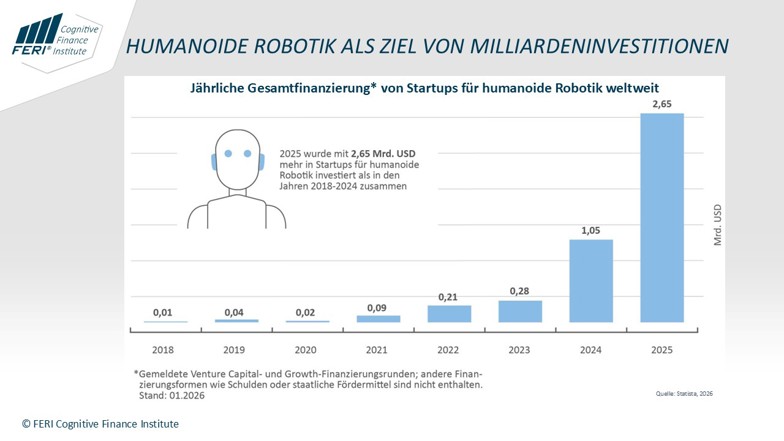
Investment in humanoid robotics is reaching new heights. In 2025, approximately $2.65 billion flowed into companies in this sector—more than in the years 2018 through 2024 combined. And this figure represents only a fraction of the total investment in humanoid robotics. This wave of investment underscores investors’ high expectations for a new generation of intelligent robotics.
With recent advances in artificial intelligence, sensor technology, and hardware development, the economic conditions for the deployment of humanoid robotics are improving. Today, robots are potentially capable of far more than just executing preprogrammed tasks: they are evolving into adaptive, learning systems that can perceive their environment, process information, and respond flexibly to new situations. This convergence of artificial intelligence and robotics thus lays the foundation for “Physical AI.” This opens up interesting application prospects: Industry, logistics, healthcare, and many other sectors are seeking automated solutions for repetitive tasks and to address labor shortages.
Market forecasts for humanoid robotics are ambitious and predict high growth rates for the coming years. At the same time, the field is in an early stage of market development: an established mass market does not yet exist, and technological and regulatory challenges remain significant.
A new study by the FERI Cognitive Finance Institute, produced in collaboration with Fraunhofer IPA, will soon offer a comprehensive perspective on the field of AI-based robotics, covering technological breakthroughs, economic potential, and structural challenges.