Set this page to:
Go to FERI in:
 CONTACT
 CONTACT
 Login
 Languages

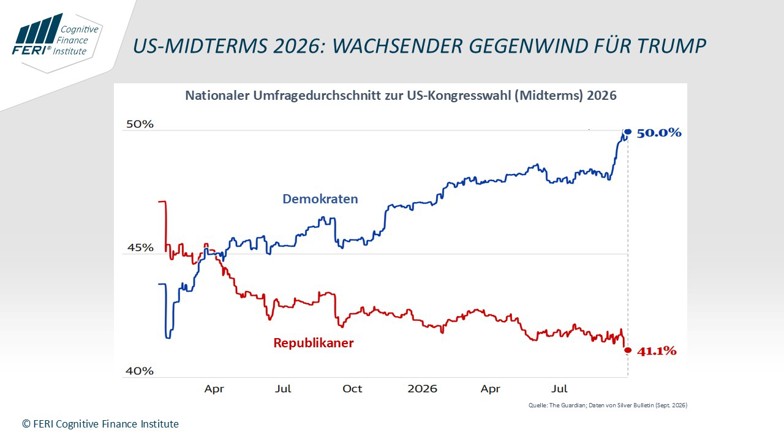
The political mood in the U.S. has shifted: Ahead of the midterms—the elections for the U.S. Congress—polls point to growing momentum for the Democrats. However, even a Congress dominated by the Democrats would have only limited room to maneuver. High national debt and rising interest burdens are imposing strict limits on policymakers and putting increasing pressure on the Federal Reserve. For investors, this brings the fundamental risks of the U.S. financial system into sharp focus.
For President Trump’s administration, they are an important barometer of public sentiment: the 2026 midterms, that is, the midterm elections for the U.S. Congress. A shift in the trend has been evident for some time now: Since April 2025, the political climate in the United States has been shifting in favor of the Democrats (see chart). It remains to be seen whether this will result in new majorities in Congress on November 3.
The key point is this: Any new majorities will face a fiscal environment that significantly limits their political maneuvering room.
High public debt, chronic budget deficits, and rising interest expenses are increasingly limiting the U.S. government’s ability to act on fiscal policy. The FERI Cognitive Finance Institute analyzed this development in detail in its Cognitive Comment (in German) titled „Das Dollar-Dilemma: Schuldenfalle, Finanzrepression und digitales Geld – Powerplay um die Zukunft des US-Finanzsystems“.
At the same time, pressure on the Federal Reserve is mounting. It must increasingly take into account the affordability of the national debt. This „fiscal dominance“ could significantly restrict its freedom of action in monetary policy.
The international role of the U.S. dollar is also changing. Central banks are increasing their gold reserves, alternative payment systems are gaining importance, and major creditors are reducing their holdings of U.S. Treasury bonds.
Added to this is the geopolitical dimension: The use of the dollar system as an instrument of political power increases the incentive for other countries to reduce their dependence on the U.S. currency.
At the same time, stablecoins open up new opportunities for the U.S.: They can expand the dollar’s reach in digital financial markets and create additional demand for U.S. Treasury bonds. But this can also create new systemic risks.
For investors, the stakes go beyond the outcome of a congressional election. Growing fiscal constraints and the structural transformation of the U.S. financial system raise fundamental questions regarding currency risks and strategic asset allocation.
For more on the structural changes in the U.S. financial system and their potential consequences, see the Cognitive Comment (in German) „Das Dollar-Dilemma: Schuldenfalle, Finanzrepression und digitales Geld – Powerplay um die Zukunft des US-Finanzsystems“ in the download section of this page.